
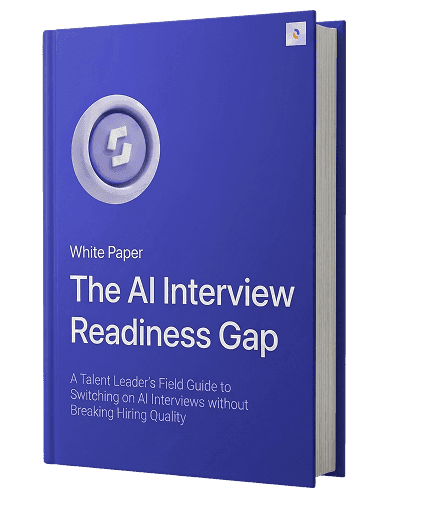
White Paper
The AI Interview Readiness Gap
A talent leader's field guide to switching on AI interviews without breaking hiring quality.
Most hiring systems don't fail loudly. They fail slowly. Time-to-hire stretches, interviewer quality drifts, and teams respond by adding rounds instead of clarity. This field guide shows you how to switch on AI interviews the right way, by treating adoption as a system design problem, not a tooling upgrade.
Free PDF · 16 pages · no account needed
The AI interview readiness gap is the distance between switching on AI interviews as a tool and having a hiring system clear enough for AI to actually improve it. AI amplifies whatever design already exists: if the system is clear, AI increases consistency and throughput; if it is unclear, AI scales confusion faster.
“AI interviews are not a replacement for interviewers. They are a mirror reflecting the maturity of your hiring design.”
01
Assess your readiness
Use operational checkpoints to evaluate your current hiring design before you enable AI interviews.
02
Shift your paradigm
Move from interviewer-dependent judgment toward structured, system-driven signal capture.
03
Scale consistency
Operationalise hiring intelligence to raise throughput and consistency without losing judgment.
What's inside the white paper
Sixteen pages of frameworks and checklists you can put to work the same week. Here is what the full paper covers.
- 01
The 5-layer AI interview readiness model
Evaluate readiness across role clarity, signal design, evaluation logic, candidate experience, and the feedback loop, with the typical failure mode and what good looks like for each.
- 02
Tactical readiness checklists
Role clarity, signal design, and evaluation logic checklists to run before enabling AI interviews, so you catch ambiguity instead of amplifying it.
- 03
A first 30 days implementation plan
A week-by-week plan, from defining success outcomes and building your scoring rubric to piloting and calibrating on real results.
- 04
Real case patterns
Anonymized adoption scenarios for high-volume, specialized, and experience-led hiring, each with the intervention and the lesson behind it.
- 05
A maturity model and executive quick audit
See which of four maturity stages your organization sits in today, plus a one-page self-assessment to spot the red flags before you scale.
The 5-layer AI interview readiness model
Before switching on AI interviews, evaluate readiness across five design layers. The full paper maps each layer's typical failure mode and what good looks like.
Layer 1
Role clarity
“Do we know what success looks like?”
Layer 2
Signal design
“What signals actually matter?”
Layer 3
Evaluation logic
“How will decisions be made?”
Layer 4
Candidate experience
“Is the flow coherent?”
Layer 5
Feedback loop
“Are we learning from outcomes?”
Key takeaways for talent leaders
- AI interview success depends more on preparation than on technology.
- The biggest failures come from unclear evaluation criteria, not AI performance.
- The shift is from interviewer-dependent judgment to system-driven signal capture.
- Readiness can be assessed using a small set of operational checkpoints.
- Teams that treat AI adoption as a hiring redesign outperform teams that treat it as a tool rollout.
Get the full field guide
Download the complete 16-page white paper, with every framework, checklist, and the executive quick audit, to share with your hiring team.
FAQ
Common questions
Close your readiness gap
See how Zinterview turns structured signal capture into consistent, evidence-backed hiring. Book a demo, or start a free trial.